Online auctions can be a wonderful place to find vintage paintings for your home. You can browse sales across the country, discover artists you’ve never heard of and follow something lovely without leaving the sofa.
Getting started can feel less straightforward. There are different types of sale, descriptions that take some deciphering and paintings photographed in ways that leave quite a lot to the imagination.
I’m Annalise Holasz, founder of Hue + Holasz, and I buy paintings at auction seven days a week. Finding them is a large part of my working life. If you’re curious about buying vintage art at auction, these are the basics I’d get familiar with before placing your first bid.

Can you buy vintage paintings at online auction?
Yes. Many auction houses publish their catalogues online and accept remote bids, so you don’t need to attend in person to take part.
Some hold dedicated picture sales. Others include paintings among furniture, ceramics, silver and general antiques. An interesting work might be in a specialist art auction or sitting halfway through a much broader catalogue.
That variety is part of the appeal. It also means the amount of information available can differ considerably between sales.
For someone buying for their own home, there’s no need to rush. You can spend time looking, work out what you’re drawn to and wait for a painting you actually want.
How do online art auctions work?
You’ll usually come across live auctions and timed auctions.
In a live auction, an auctioneer works through the lots in sequence. You can follow remotely and bid online, sometimes with an audio or video feed.
In a timed auction, bidding is open for a specified period, with a scheduled closing time for each lot. Read the instructions for the individual sale, because bidding and closing arrangements vary.
A lot is the item, or group of items, being sold. Each has its own catalogue number and description.
You’ll generally need to register before bidding. Having an account on an auction platform doesn’t necessarily mean you’re approved for every sale it lists, so give yourself time to complete the individual auction house’s requirements.
Start with a watchlist, rather than a bid
There’s absolutely nothing wrong with browsing auctions and buying nothing. In fact, I’d recommend doing that first.
Save a few paintings you like and follow them through the sale. You’ll start to recognise the kinds of work that attract your attention and get more comfortable with how an auction progresses.
It’s also a useful way to distinguish between something you genuinely want and something you’re tempted by because it happens to be available.
Watchlists and search alerts help you keep track. Otherwise, it’s surprisingly easy to forget which catalogue contained the painting you saw while doing something else.
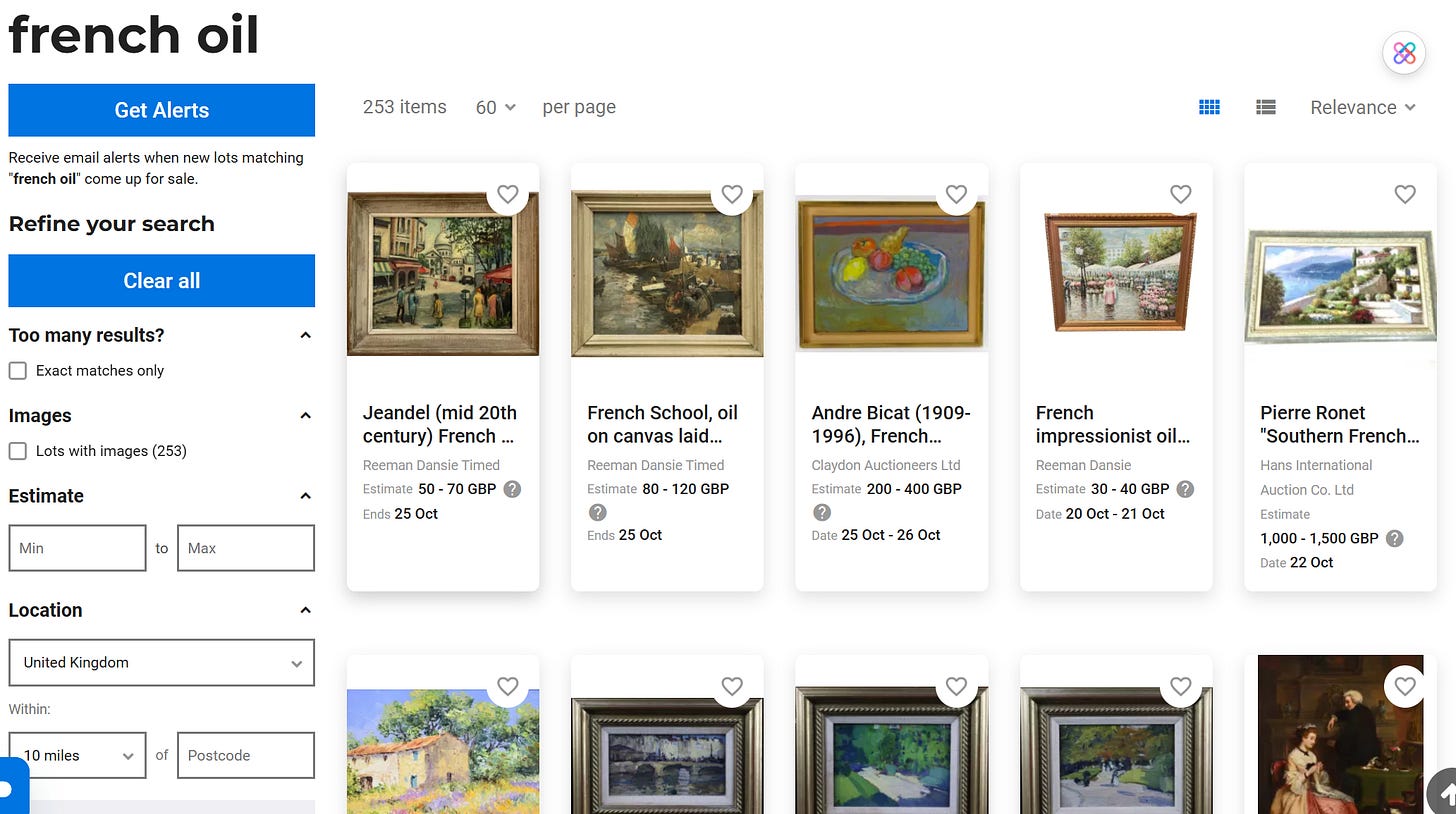
How to search for vintage art at auction
Auction catalogues don’t all use the same language. The words you’d use to describe a painting might be quite different from those chosen by the auction house.
Try searching in a few ways:
-
By subject: landscape, still life, portrait or coastal scene.
-
By medium: oil painting, oil on board, watercolour or drawing.
-
By artist: if there’s someone whose work you already know and enjoy. You can find some of artists I love listed in this post: 20 SWEDISH ARTISTS TO KNOW WHEN BUYING VINTAGE PAINTINGS – Hue + Holasz
Broad searches take longer to look through, but they can reveal things a narrow search misses. If one phrase brings up very little, try another.
Keep the location in mind, too. An auction platform may list objects from many different auction houses. They aren’t all waiting in one warehouse, and the location can affect whether a painting is practical for you to buy.
Read the painting’s description, not just the photograph
A good photograph can make you stop scrolling. The catalogue entry is where you begin establishing what you’re actually looking at.
Read the full description and look through every available image. For paintings, I’d pay particular attention to three things.

Is it a painting, drawing or print?
Check how the medium is described. A framed picture isn’t necessarily an original painting, and a textured surface alone doesn’t tell you what something is.
If the description is unclear, ask rather than filling in the gaps yourself.
I’ve explored some of the distinctions in Before You Buy That ‘Original Oil’ on The Trove, including factory paintings and oleographs that can cause confusion when buying vintage art.
What size is it?
Photographs give you very little sense of scale. Check the dimensions, and whether they refer to the artwork itself or the full framed size.
If that isn’t clear, ask. Then get a tape measure out at home.
Size changes how a painting feels. A small landscape might be perfect tucked into a bookcase, while a much larger version would need an entirely different setting. Knowing the measurements helps you imagine the actual object in your home.

What does the artist description mean?
An artist’s name in a listing may be qualified by wording such as “attributed to”, “after” or “bears signature”.
Those phrases aren’t interchangeable. If you don’t understand the wording, check the auction house’s catalogue glossary or ask it to explain.
You don’t need to become an expert in auction terminology before you start browsing. You do need to understand the description of anything you decide to bid on.

What this introduction doesn’t cover
Finding a painting you like is the enjoyable beginning. There are further questions to resolve before committing: its condition, the auction’s charges, your bidding limit and how you’ll get it home.
The winning bid may not be the final amount you pay, and delivery isn’t something to assume is included or available.
Those are the parts I cover in detail in Buying at Auction? Ask an Addict, my guide on The Trove. It takes you through the buying process, including estimates, condition enquiries, budgeting, bidding and organising collection or shipping.
If you’ve started saving lots and are thinking about your first purchase, that’s the next piece to read.
Read Buying at Auction? Ask an Addict on The Trove

Is buying vintage art at auction right for you?
If you enjoy looking closely, researching and waiting for the right thing, auctions can be a very rewarding way to find art.
You don’t need to recognise every artist. You can begin with what you like, learn how the catalogues work and get comfortable asking questions. There’s no obligation to buy simply because you’ve registered or followed a sale.
If you’d prefer to choose from paintings someone has already sourced and selected, that’s what I do at Hue. You can browse our available vintage original paintings, each chosen by me for the collection.
And if you’re drawn to the hunt, start looking. You can learn a surprising amount before placing a single bid.
Written by Annalise Holasz, founder of Hue + Holasz, specialising in vintage original oil paintings for modern homes.